Imagine you took the pieces of a 50-piece puzzle and stuffed them in your pockets. Then you went around town, doing your daily activities, dropping a piece here and a piece there. You might leave one at your desk at work and one in the copy room. One will be left on the counter at the post office and another in your grocery shopping cart. One piece will get tucked into your child's backpack and one will be on the treadmill at the gym. When all the pieces are gone, they are so widely scattered that no one will ever be able to put the puzzle together again.
Now imagine that the pieces are figurative and invisible. The pieces to the puzzle are words that you say to your best friend, to your mother, as a comment on a stranger's blog. There may be a story there, but if they are still scattered, no one will ever be able to decipher what was being said.
Or perhaps your words are all delivered to one individual over the course of weeks, months, even years. Maybe they are hints to a special someone how much they mean to you but taken in small doses over time, they don't realize what it is you're saying. Maybe you have given them all of the pieces but they never knew there was anything to be assembled or other meanings hidden within.
Leaving pieces of a puzzle behind is one way to write a mystery (something I have never done) but it can also be used in any type of fiction writing. The pieces may all be leading somewhere or to some revelation that only the author knows. Keen readers might pick up on it before the truth is revealed, while others will only look back and discover that the pieces of the puzzle were there all along, they just hadn't been paying close enough attention.

Wednesday, February 8, 2012


Friday, February 3, 2012
What Doesn't Kill Us
I am not a winter person. I used to be able to handle it much better. In fact, whenever anyone asked me what my favorite season was, I would say that the start of each new season was what I liked best. That would, of course, include the first snowfall. Not anymore. This has been an incredibly mild winter, but the few snowfalls we have had have elicited no joy from me.
Considering how "nice" this winter has been for nonwinter types such as myself, you'd think I wouldn't have much to complain about. While it certainly is an easier winter in some aspects, it is not easier altogether. The bit of snow we have turns into radiation fog on days above freezing, which is most of them. Fog is depressing to me. The air is cold and wet and seeps through your clothing. Staying inside doesn't help because I feel claustrophobic, not being able to see to the end of the block. The lack of sun, sometimes for days on end, makes me feel like I am hardly tethered to the Earth, as if I am separate from everything and drifting away. Calling winter "soul-sucking" almost feels literal - as if there is a wobbly, quivering droplet in my chest that is trying to make an escape, to flee and find a place less depressing than this.
But there is something good that can come from all of this unhappiness. When something hurts us or scares us or depresses us, we can experience it, fight through it, and then document it. I believe that as writers, whatever doesn't kill us makes for good material. If I am feeling down, I can sit at my computer and write a scene in which the character is as low as I am and try to give it that genuine emotion that I am feeling as I type. Or, for example, if I do something out of my comfort zone, I can better relate to my characters when they are put in awkward situations. Any bad life experience I've had can be used to my benefit, as long as I have the courage to relive it and put it on paper. And the nice thing about writing fiction is that I can channel real negative emotions into a different storyline and even forget, if only temporarily, what it was that I was upset about. Writing is good therapy.
Considering how "nice" this winter has been for nonwinter types such as myself, you'd think I wouldn't have much to complain about. While it certainly is an easier winter in some aspects, it is not easier altogether. The bit of snow we have turns into radiation fog on days above freezing, which is most of them. Fog is depressing to me. The air is cold and wet and seeps through your clothing. Staying inside doesn't help because I feel claustrophobic, not being able to see to the end of the block. The lack of sun, sometimes for days on end, makes me feel like I am hardly tethered to the Earth, as if I am separate from everything and drifting away. Calling winter "soul-sucking" almost feels literal - as if there is a wobbly, quivering droplet in my chest that is trying to make an escape, to flee and find a place less depressing than this.
But there is something good that can come from all of this unhappiness. When something hurts us or scares us or depresses us, we can experience it, fight through it, and then document it. I believe that as writers, whatever doesn't kill us makes for good material. If I am feeling down, I can sit at my computer and write a scene in which the character is as low as I am and try to give it that genuine emotion that I am feeling as I type. Or, for example, if I do something out of my comfort zone, I can better relate to my characters when they are put in awkward situations. Any bad life experience I've had can be used to my benefit, as long as I have the courage to relive it and put it on paper. And the nice thing about writing fiction is that I can channel real negative emotions into a different storyline and even forget, if only temporarily, what it was that I was upset about. Writing is good therapy.
Thursday, January 12, 2012
Blogging about Everything Is Blogging about Nothing
I thought when I started this blog that it would be a good catchall - pics from my recent vacation or nature photos, thoughts that I needed to write down or ideas I needed to hash out for my book, and so forth. But it turns out that having a blog with no focus is the same as not having a blog because you never know what to write about so you just don't.
I guess the smartest thing for me to do here is to blog about my writing. Although I certainly don't want to take time away from my writing to do more writing... but if it helps me get back on track, it's worth it. We'll see.
I was rereading everything I had written and a certain scene and some lines stood out to me. I wrote these many months ago (this is a hint of how little I've written in the past months). One of my characters says, "There's a reason they call it falling. Falling in love is something that happens whether you want it to or not." (Want to know who says it? You'll have to wait and read the book to find out.)
I believe this statement to be true. When was the last time you fell in love? Was it yesterday? Or was it twenty years ago? Or are you one of those lucky souls who falls in love with your significant other every time you see him or her again? Maybe you have fallen in love with a new baby, or maybe you went on vacation and fell in love with a place. Even an idea that you can't stop thinking about can be something you fall in love with. Falling, like an earlier blog I wrote about Lucia Joyce, is something that is out of your control.
When I visit national parks and step out of my car or pause on the trail and stand back and gaze at the vista, whatever feelings rush at me are out of my control. It is simply the way I instinctually feel about something. I suppose I could stand there and stare at the reddish depths of the Grand Canyon and try to find fault. Or I could try to devalue the beauty of Glacier National Park by saying, "Sure, it's lovely in August, but the rest of the year it must be a nightmare." That's not really being true to myself, though. Authentic and pure emotion is part of what makes these trips around the sun worthwhile. Falling can be frightening or blissful, but it's always a rush.

I guess the smartest thing for me to do here is to blog about my writing. Although I certainly don't want to take time away from my writing to do more writing... but if it helps me get back on track, it's worth it. We'll see.
I was rereading everything I had written and a certain scene and some lines stood out to me. I wrote these many months ago (this is a hint of how little I've written in the past months). One of my characters says, "There's a reason they call it falling. Falling in love is something that happens whether you want it to or not." (Want to know who says it? You'll have to wait and read the book to find out.)
I believe this statement to be true. When was the last time you fell in love? Was it yesterday? Or was it twenty years ago? Or are you one of those lucky souls who falls in love with your significant other every time you see him or her again? Maybe you have fallen in love with a new baby, or maybe you went on vacation and fell in love with a place. Even an idea that you can't stop thinking about can be something you fall in love with. Falling, like an earlier blog I wrote about Lucia Joyce, is something that is out of your control.
When I visit national parks and step out of my car or pause on the trail and stand back and gaze at the vista, whatever feelings rush at me are out of my control. It is simply the way I instinctually feel about something. I suppose I could stand there and stare at the reddish depths of the Grand Canyon and try to find fault. Or I could try to devalue the beauty of Glacier National Park by saying, "Sure, it's lovely in August, but the rest of the year it must be a nightmare." That's not really being true to myself, though. Authentic and pure emotion is part of what makes these trips around the sun worthwhile. Falling can be frightening or blissful, but it's always a rush.

Tuesday, October 18, 2011
Losing My Characters
A funny thing happened on my way to finishing my latest book. My characters all packed their suitcases and trunks, donned their jaunty caps, and left. I haven't been able to bring them back into my thoughts for a few months now. Which means, of course, that I haven't been able to write anything. I just assumed that eventually my daydreams about them would come back and we would pick up where we left off, which was more than halfway through the next book, but Evelyn and her entourage are nowhere to be found. Have they grown tired or me? Have I grown tired of them? Or have I simply become too busy for an imaginary world? I think the last one is the most true.
There is also the sticky problem of having to hurt characters you love. I left the last book with Evelyn getting what she wanted and happiness being just on the horizon. And in order for there to be any plot in the sequel ... let's just say bad things have to happen. I have already worked out the main dilemmas for this book and the one or two that will follow, but I know that what happens is going to upset my readers. Now that I have released the first book into the universe and people other than me know who these characters are, it is harder for me to manipulate them because I feel the pressure and expectations on me not to harm those they love.
Because of the additional pressures and the fact that I have not written anything in months, the idea of running away seems very tantalizing right now. Which is why my finished but unpublished book about people fleeing for their lives, A Different Sky, is calling to me. I'm starting to think I should switch over to rereading and editing that book and worry about Evelyn's life when I am done with A Different Sky. But then I think maybe I'm just making excuses for why I don't have to dig back into Evelyn's story.
So, what do I do? Do I force myself to get back into the sequel to The Gathering Storm, or do I let it lie for a while and work on editing A Different Sky? Or do I, as I have been doing for months now, make no decision at all and simply make excuses while I continue to do nothing?
Any shove in either direction is greatly appreciated.
There is also the sticky problem of having to hurt characters you love. I left the last book with Evelyn getting what she wanted and happiness being just on the horizon. And in order for there to be any plot in the sequel ... let's just say bad things have to happen. I have already worked out the main dilemmas for this book and the one or two that will follow, but I know that what happens is going to upset my readers. Now that I have released the first book into the universe and people other than me know who these characters are, it is harder for me to manipulate them because I feel the pressure and expectations on me not to harm those they love.
Because of the additional pressures and the fact that I have not written anything in months, the idea of running away seems very tantalizing right now. Which is why my finished but unpublished book about people fleeing for their lives, A Different Sky, is calling to me. I'm starting to think I should switch over to rereading and editing that book and worry about Evelyn's life when I am done with A Different Sky. But then I think maybe I'm just making excuses for why I don't have to dig back into Evelyn's story.
So, what do I do? Do I force myself to get back into the sequel to The Gathering Storm, or do I let it lie for a while and work on editing A Different Sky? Or do I, as I have been doing for months now, make no decision at all and simply make excuses while I continue to do nothing?
Any shove in either direction is greatly appreciated.
Wednesday, August 17, 2011
What I'm Thinking About Today
"Whatever spark or gift I possess has been transmitted to Lucia," James Joyce once said of his troubled daughter, "and it has kindled a fire in her brain." Carl Jung, who treated Lucia for schizophrenia, described Lucia and her father as "two people going to the bottom of a river, one falling and the other diving."
Compulsive, troubling thoughts that burrow deep into your existence and expose your weaknesses and anxiety can be used to an artist's advantage or lead to anyone else's undoing.
It's possible to begin as the person diving, and at some point realize on your way down that you've lost all control and that you're now falling and unable to save yourself from a hideous fate.
Is it also possible to start out falling and somehow gain control and recover with a respectable dive before you hit bottom?

Wednesday, May 18, 2011
Photographing the Constellations
I have always wanted to take respectable photos of the night sky, but because I never had the appropriate equipment, I was never able to succeed. But it was not without trying. I would turn off the flash on my camera and the shutter would open for a fraction of a second longer than a normal photo. I could get passable photos of bright planets while there was still some sunset colors in the sky. What I really needed was to mount an SLR camera on a tripod and be able to leave the shutter open for seconds at a time. Last night, I finally succeeded.
This picture of the Big Dipper makes the double star of Mizar and Alcor in the handle easy to see. When I look at this photo on my computer and zoom in, I can star hop to where M101 would be, although it does not show up in my picture. But it will definitely help me find my way to it the next time I have my telescope out.


At center in the following photograph is the bright star Vega, which appears nearly overhead in the summertime. Vega is in the constellation of Lyra the Lyre. Lyra can be seen as the parallelogram below Vega.


This picture of the Big Dipper makes the double star of Mizar and Alcor in the handle easy to see. When I look at this photo on my computer and zoom in, I can star hop to where M101 would be, although it does not show up in my picture. But it will definitely help me find my way to it the next time I have my telescope out.

Auriga is not a very easy constellation to spot, but this picture makes it simple. The orangish star is Capella, which nearly sparkles like a firework in real life. The other stars around it that make up the constellation Auriga form nearly a J shape.

At center in the following photograph is the bright star Vega, which appears nearly overhead in the summertime. Vega is in the constellation of Lyra the Lyre. Lyra can be seen as the parallelogram below Vega.

Below, Saturn is right next to the star Porrima in Virgo. The brightest star in Virgo, Spica, is to the lower left.

Next is Leo the Lion. The lion is tipped as if he is heading downward at an angle. His body is the triangle on the left and his head is the backward question mark on the right.

Lastly is Gemini the Twins and Canis Minor. The twin stars include Pollux, the orangish star on the top left, and Castor, the bluish star on the top right. You can trace their stick bodies below. At the bottom left of the photograph is Canis Minor, the Lesser Dog, with the bright star Procyon and a dimmer star named Gomeisa.

Tuesday, May 17, 2011
Best Hikes on our Trip to the Southwest
After our spring break trip to the southwest in April 2011, we all picked our three favorite hikes from vacation. Here are our picks.
My husband and daughter chose the hike down Bright Angel Trail at the Grand Canyon as one of their favorites. You can see the trail at left in this photo as it leads to the edge of Plateau Point. Someday we will hike all the way down there, but with young kids, this trip was not the one. Instead we hiked for about a half hour down.

We met riders on mules (which look awfully big to me, more like horses?) on our way down. You can still see Plateau Point at the photo's center left.

Both kids and adults chose the hike/scramble up Bell Rock in Sedona as one of their favorites. There is a trail marked by rock cairns in chicken wire that suggest the best route, but it's easy to lose your way. The safest way down if you can't find a marker is to look for the cracks with the rock falls. In the pic below, you may get up that way, but good luck following that same path down.

This hike also had the most beautiful views of our entire trip.

Another of my son's favorite hikes was Blue Mesa in Petrified Forest National Park. I only made it the first 100 yards or so on this one, because I was recovering from food poisoning. It's about a mile round trip and coming up the last part is quite steep.

I spy with my little eye...

One of my favorite hikes was the one to White House Ruins in Canyon de Chelly National Monument. The White House Ruins are in and at the bottom of the wall.


Note the green arrow carved into the rock floor. This hike down involved a tunnel and caves.
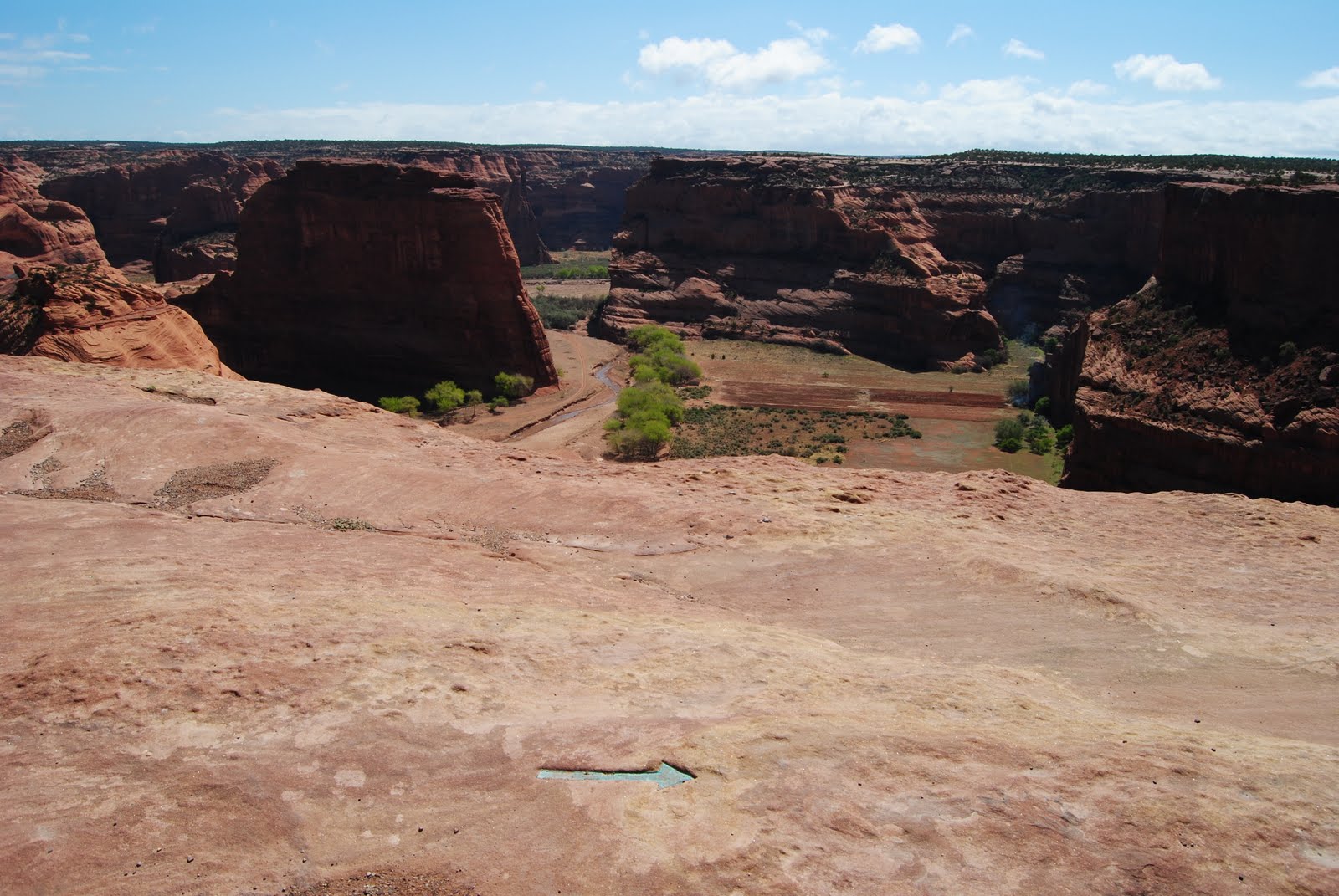
A farmer was burning something at the base of one of the cliffs (smoke on right). This switchback trail had sharp drop-offs that is not well-illustrated by these photos.

Another favorite hike was at Great Sand Dunes National Park. Although there is not a definite trail that leads to the top because of the shifting sand, there is a post to let you know when you've gotten to the top. I can't say I've seen it in person. You may hike all over the sand dunes and make your own trails. Most people hike up the ridges and slide, jump, or roll down the steep edges.


Normally there's a stream at the base of the Great Sand Dunes that comes from the melting ice on the nearby mountains. Medano Creek, as it is named, was so dry that it had crept far back into the mountains and we didn't see it or have to cross it this time to get to the dunes. This was a great bonus in that the water is usually frigid, and on a day when the air temperature was in the 40s, we were happy to avoid the wet feet. The sand, however, was still plenty hot under our feet.
Our final favorite hike was just outside Great Sand Dunes National Park, where you'll find a small sign for Zapata Falls. You turn onto a rocky road maintained by the BLM and drive for a few miles up the side of a mountain. The parking is by a lookout area and then the trail is a rocky path that leads higher up on the mountainside. We were fortunate to be there when the creek that flows from Zapata Falls was still frozen, which allowed us to hike on it to get back into the gorge and see the actual waterfall. The waterfall is hidden within the rocky canyon. It was still partly frozen but you could hear and see the water falling behind the sheet of ice.

The way to the waterfall is through the dark, narrow passage at back left.


Photo looking up:


I hope you get to experience one of these hikes soon!
Subscribe to:
Posts (Atom)